Showing posts with label Live Events. Show all posts

Sunday, March 20, 2022

How-to Join as external attendee an access-controlled Teams Live Event without explicit Teams Guest Access

MS Teams Live Event is current the only service in the Microsoft 365 landscape that enables audience outside the own organization. Teams Live Event supports both full public (anonymous) Live Events without any access control, as well as Live Events with the permission mode 'People and Groups'. In the last mode, also externals can on named base be allowed by applying the Azure AD B2B guest concept. Besides that (1) the external must be known in the identity system of the tenant in which the Teams Live Event is produced, another requirement (2) is that the external must switch in Teams first to that tenant aka 'Organization' before allowed to join the Teams Live Event.
For reference, below the prerequisites to enable external to attend a Teams Live Event in your tenant.
On Organizing part
  • For each external that needs to be granted access, provision an Azure AD B2B guest account
  • Schedule in Teams a Live Event, with permission type: People and Groups
  • Authorize all the externals via their provisioned Azure AD B2B guest account for access to that Teams Live Event
  • Share the attendee link with the invited externals
Per external
  • Redeem the provisioned Azure AD B2B guest account
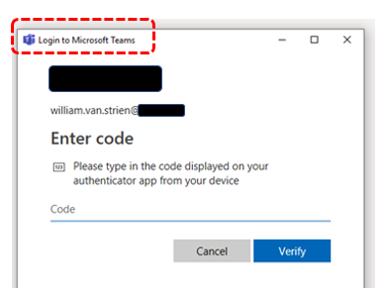
  • Enroll for Azure MFA via MS Authenticator App; against the organizing tenant
  • In Teams context; first explicit switch to ‘<organizing> tenant’ ⇒ without this, Teams displays message that you are prohibited to access
  • Then click the attendee link ⇒ and the external will be allowed to access
Externals that are authorized via Teams Guest Access concept in any arbitrary team in the organizing tenant, can do this 'tenant-switch' direct in the Teams App and web application, via so-called 'tenant-switcher':
For externals that are not within any team, there is no reason for the Teams App and web application to list that tenant as organization within the 'tenant-switcher'. The easy way out is then to just add all the authorized externals to 'a' team in the organizing tenant. But for multiple reasons this is not always a preferred / good approach. For one, it doesn't "feel right" to add persons to a team with its full set of capabilities, only because they are invited to participate in a temporary digital event. Also as all members of a team instance can 'see' all the other members, and then contact each other; via teams chat, or via the discovered email addresses. For privacy and compliance reasons the event organization might not want this, or even not be allowed to do. Another reason has to do with timing aspect: in the Teams operational model it takes unpredictable yet significant time (can take up to 36 hours) after adding an external to a team instance, before the external sees the effect of this in the 'tenant-switcher' of the own local Teams App.
Luckily there is an alternative approach in which the externals can do the 'tenant-switch'. Namely by visiting in the browser the link "https://teams.microsoft.com/?tenantId=<organizing tenant-id>". The external must then sign-in via his/her Azure AD B2B guest account, and typical also answer on multi-factor authentication challenge (imposed by the organizing / inviting tenant), and if both successful the external is then allowed in the Teams context of the event organization. For the externals that are not member of any team, Teams will display the message "You’re currently not part of any teams…".
And now from this context in Teams, the external can join via the attendee link the Teams Live Event. Be aware that this approach only works from the browser via Teams web application, the external can not watch the live event in the Teams App. But on user experience that makes no difference; Teams App and Teams web application have same behavior wrt Teams Live Event.
Update:It is also possible to achieve both via one single link: making the attendee link of the Teams Live Event tenant-switch enabled. The trick is to insert "/_?tenantId=<organizing tenant-id>" immediate after "https://teams.microsoft.com" and before the "/l/meetup-join/..." part. On navigating to this link, the browser (1) first switches in Teams Web Application to the referred tenant, and (2) next from that context it joins the Teams Live Event in that same tenant.

Friday, October 16, 2020

Tip: how-to self-produce without external encoder into MS Stream Live Event

Webcast production for a Microsoft Stream Live Event is default tied to external encoder. Teams Live Event supports this also, but defaults to simple self-production via Teams App itself. In that case, the live event is not distributed via Stream; nor is the event recording stored within MS Stream. Instead Teams uses its internal Azure Media Services based streaming, and stores the recording somewhere for period of max 180 days after the event is over. Yammer Live Events takes a middle road, or the best of 2 worlds. It supports the same 2 production approaches as Teams - external encoder or via Teams. However, the difference is here within the Teams production handling. Even although produced as a simple Teams Live Event, under the hood this does use Microsoft Stream for the webcast distribution and processing, and after the live event is stopped for the storage of the recording for on-demand watch.
This opens multiple advantages
  • It allows to use the simplicity of Teams production for a webcast, and still embed the video on an event portal (typical hosted via SharePoint Online);
  • It prevent the need for and availability of external encoder (e.g. Wirecast-S, TeraDeck, OBS Studio, ...);
  • Corporations that have employed Ramp Multicast+ as eCDN solution to optimize and control the webcast traffic of Stream on the corporate network, can employ this also for webcasts produced via Teams
Way to apply this approach is by:
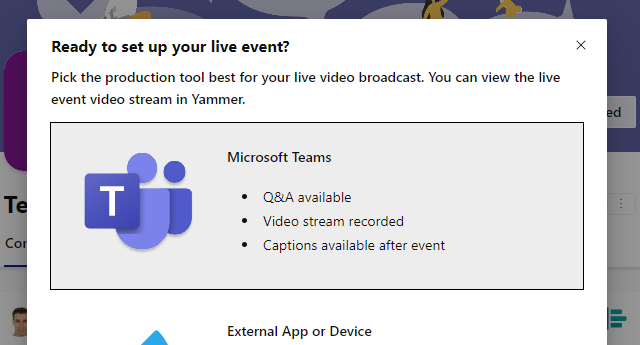
  1. Schedule your webcast as a Yammer Live Event;
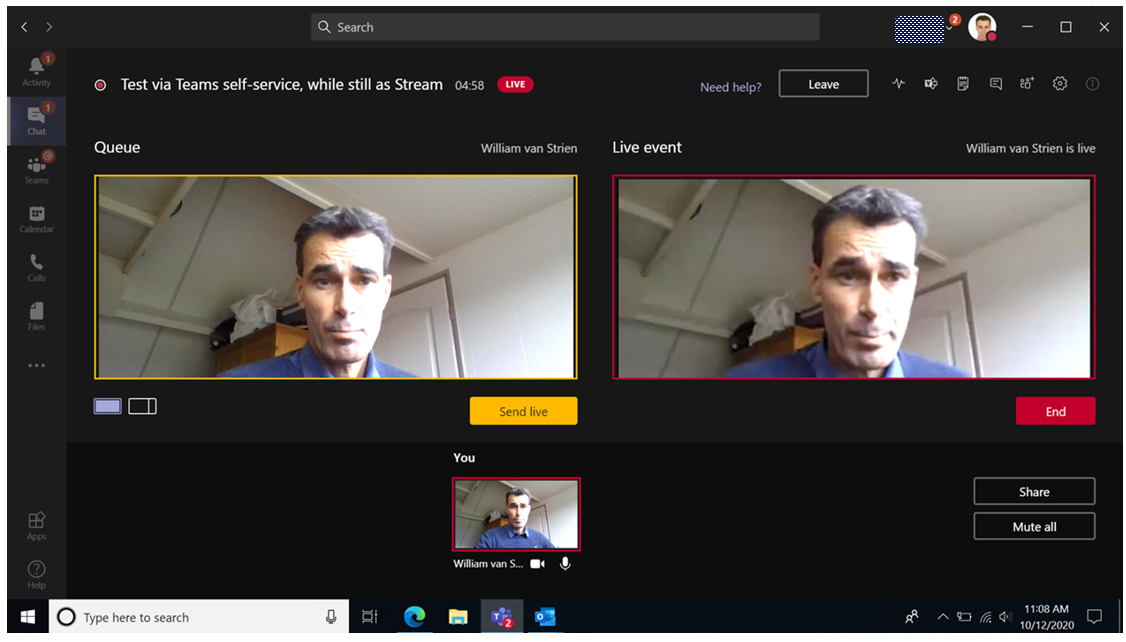
  2. Produce your webcast as a Teams Live Event;
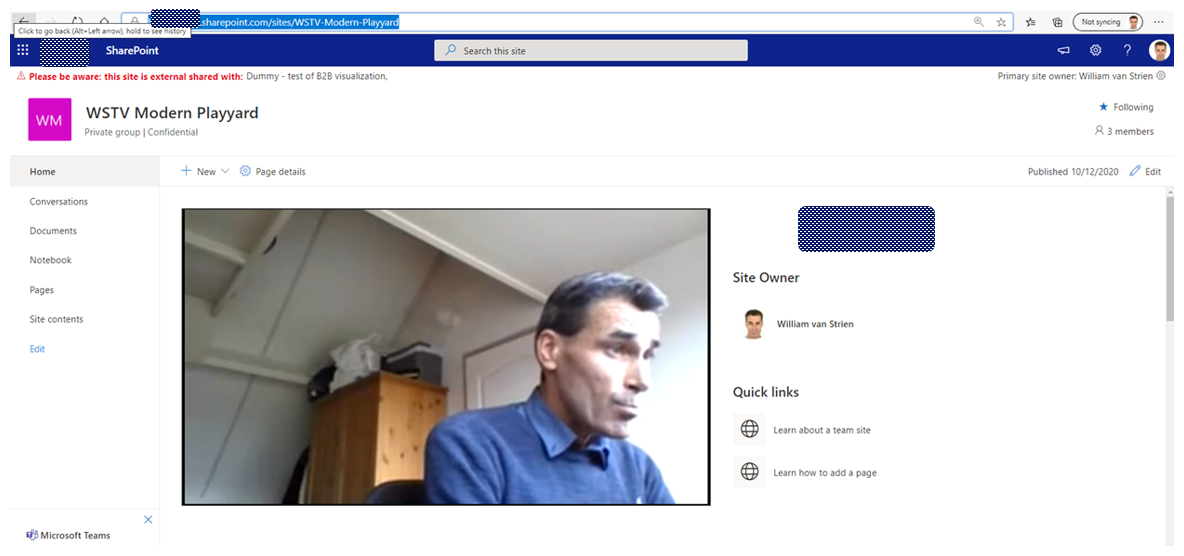
  3. Consume / watch the webcast as a Stream Live Event.
Step 1: Schedule as Yammer Live Event
Step 2: Produce as MS Teams Live Event
Step 3: Consume as MS Stream Live Event, e.g. embedded on SharePoint Online page
Yammer channel determines who is allowed to watch the live event
Something to be aware in case you would apply this approach, is that Yammer then controls who is allowed to watch the live webcast. Namely the members of the Yammer channel in which the Live Event is scheduled. So you must then make sure that all the accounts that are invited as webcast audience, are invited to the 'owning' Yammer channel. It is not possible to extend via Stream portal the permissions of the scheduled Yammer (= Stream) Live Event. After the event ended, then the video recording is 'released' for video management actions through Stream portal.

Sunday, May 31, 2020

How-To include an external as presenter in Yammer Live Event

After I earlier this week did the pleasant discovery that and how-to an external can be involved as presenter in a Teams Live Event, I decided to test whether same is possible within Yammer Live Event production. That could work, as Yammer Live Event production can be via Teams. The short report out: Yes, also this proofs possible!
The enabling preconditions (external known as Azure AD B2B guest in organizing Teams, and switched in Teams App to the organizing tenant) and steps are comparable with involving an external in Teams Live Event presentation, although few significant differences:
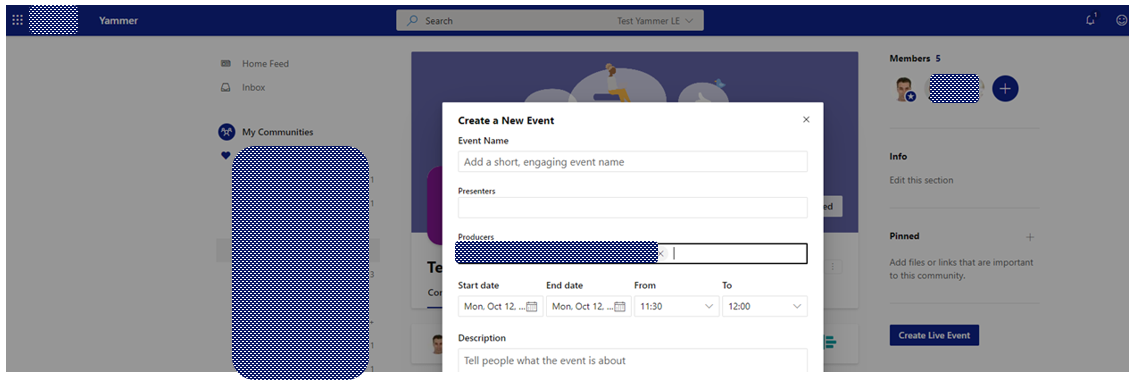
  1. In the organizing tenant, schedule in producer / organizer role within Yammer a new Live Event. Crucial also here is to select that the production will be done 'via Teams', not 'via External app or device'. In this step in Yammer UI, do not try to invite the external as presenter as that fails: Yammer does not allow the external to be resolved (unless you have enabled external access of the Yammer channel itself)
  2. In Yammer of the organizing tenant, navigate to the scheduled Live Event and click on "Produce (Open in Teams)". After the Yammer Live Event is opened in Teams App, click 'Join now'.
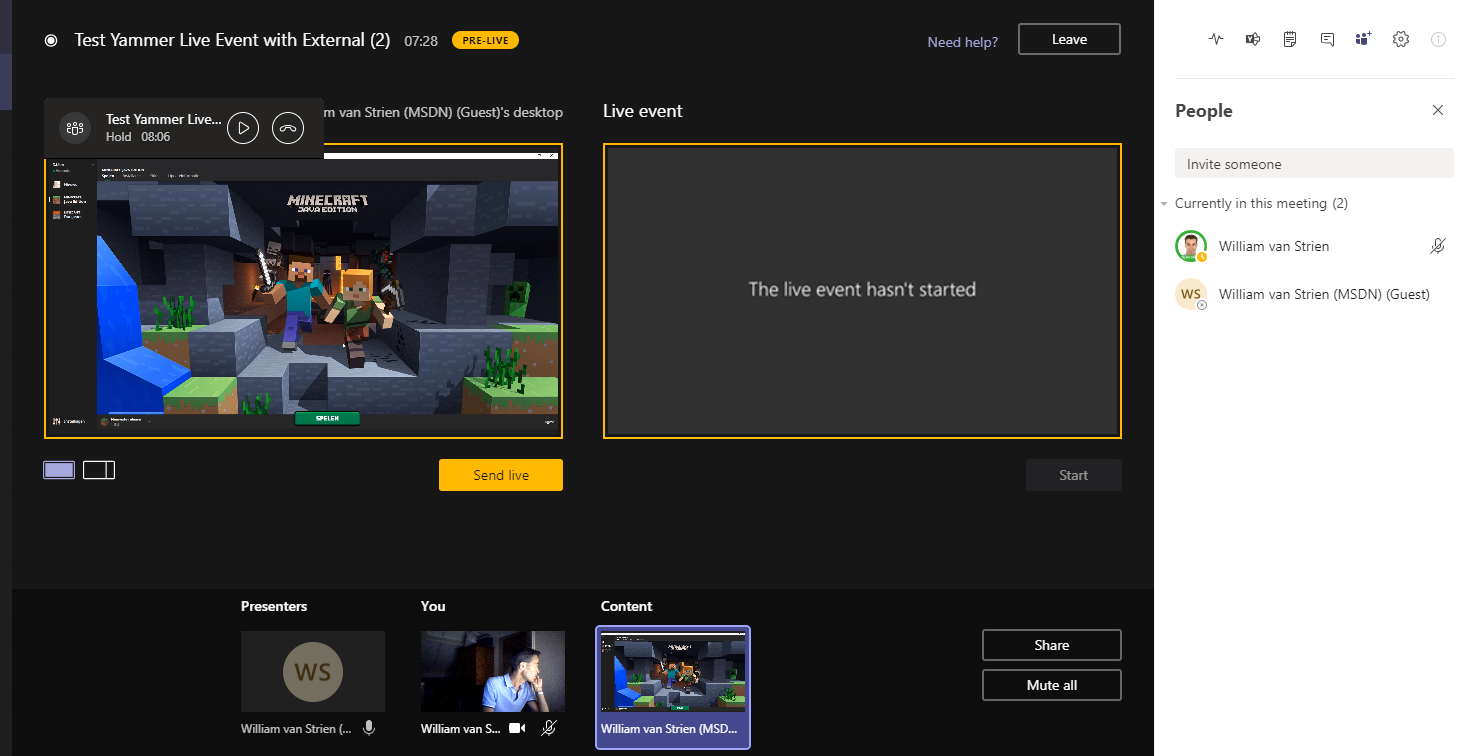
  3. Crucial step: in the internal Teams meeting of the Live Event, click on the button 'Show participants'. And in the Teams meeting context, invite the external person via his/her external guest identity;
  4. Under the preconditions that the external person is active in Teams, and switched there to the organizing tenant, (s)he receives a request notification to join in the internal Teams meeting of the Yammer Live Event
  5. The invited external accepts the invite to join this active Teams Meeting, and can then share content + video in the meeting context of the Yammer Live Event;
  6. The Yammer Live Event producer waits in the Teams Live Event production room until the external person has joined, and shares content in the internal meeting of the Live Event. When visible, the producer is in control to select content and/or video of this external presenter in the queue;
  7. The producer pushes from the queue to live, and starts the Live Event;
  8. The audience of the Yammer Live Event see the content and/or video of the external presenter;
  9. And audience on-the-go can watch the external presenter in the Yammer Mobile App;

Saturday, May 30, 2020

How-To include an external as presenter in Teams Live Event

When it comes to organizing a webcast, Microsoft 365 offers multiple options: Teams Meeting, Stream Live Event, Teams Live Event, Yammer Live Event. Each with their own differentiating characteristics, and you can select which best fits the specifics of your planned event. A significant differentiator of Teams Live Event is that you can extend beyond internal audience only. Either full public open, or still restricted audience by inviting externals as authorized via Azure AD B2B in your tenant. In the B2B guest model, the external access into the Live Event can then be secured by multi-factor authentication (MFA), to protect the company information shared for external access only in trusted context.
A pleasant discovery I did this week is that the authorized external involvement also extends to the Presenter role: you can include in the set of event presenters also identified people from outside your own organization.
The enabling conditions:
  1. The Live Event must be produced via Teams itself, not produced by External app or device. Reason is that the latter delegates to MS Stream for processing and delivery, and that Microsoft 365 service up today sadly still does not support external access;
  2. The external person must be known in your tenant, either as Azure AD B2B guest or via Teams Federation;
  3. The Live Event organizer / producer must invite the external person via his/her external guest identity in the Presenter role;
  4. The external person must be authorized as member to a Teams instance in your tenant
  5. And as first crucial: to be allowed in the Live Event as presenter, the external person must at the presentation time switch in Teams to your tenant. Without this step, the external person sees in own Teams calendar the Live Event as meeting; but when trying to join that from own tenant will be blocked with notification
    "This event is in <external-tenant>. To join, you'll need to be in that org,too."
    If the organizing tenant has enabled MFA as conditional access rule, the external person will be challenged for that before secure and governed allowed access in the organizing tenant.
  6. And second crucial: to actively join the live event the external person cannot go from Teams calendar once switched to the organizing tenant as it is not administrated there for the external person. Workaround is to join the 'external live event' via the invitation mail that the external person received in the own mail inbox when the Live Event organizer identified the external as an event presenter. Click on 'Join Live Event' seamless opens the Teams App of the external person in the internal producer/presenter meeting of the Teams Live Event within the organizing tenant. As result of the tenant-switch (previous step), the external person is now namely already authenticated and known in the organizing tenant.
After following the above steps, the external person is from perspective of the Teams Live Event organization just another presenter, who is authorized and enabled to share video and content in the event. And can communicate with the producer + other presenters in the chat of the internal Teams meeting to align on the event production.
From the perspective of the organizing producer, (s)he remains in control to determine which content of the presenters included in the Teams Live Event production to actual put live for the audience. The final control remains thus within the organization hosting the live event to its invited audience - internals, potential authorized guests, or full public-open.

Sunday, September 29, 2019

Be aware: join as MS Teams Live Events guest requires that one is pre-authenticated against the inviting tenant

With MS Teams Live Events produced via Teams (aka QuickStart) it is already supported to invite externals (MS Teams produced via External App will support it once the underlying Microsoft Stream Live Events capability supports guest access). Guest access in MS Teams Live Events by Teams is realized by utilizing the Azure AD B2B capability, similar as is done in the external sharing of a MS Teams instance itself with external guests, and also in external sharing SharePoint Online sites. Interesting is that the external does not need to be invited to any MS Teams instance of the inviting company. This makes sense, as a MS Teams Live Events instance itself is not tied to a particular MS Teams instance; it is scheduled from the MS Teams Calendar.
Guests can join the Live Event via the browser or via the MS Teams App. In case of the latter: In your joiner instruction to invited guests, please make sure to inform them that they first must authenticate themselves against your (the inviting) tenant, before trying to join the MS Teams Live Event via the distributed 'attendee link'.
No permission to join as guest in case not authenticated before
Authenticate as Azure AD guest to the MS Teams of the inviting tenant; first authentication is 'federated' against the invited guest identity administration, and next most likely second / multi-factor authentication against the inviting tenant
Once authenticated as AAD guest to the inviting MS Teams tenant, allowed to join the invited Live Events direct via the 'attendee link'

Sunday, September 15, 2019

Caveat with MS Teams Live Events: once started, your audience is fixed

Do you recognize this? You started "the party", and while in full flux you're friendly reminded that you forgot to invite your best friend... This metaphore also holds for webcasts with selected audience: as people move accross diverse departments in an organization, it is an easy miss to not authorize/invite someone new joined. And dependent on the content and information sensitivity of the information shared, even more important can be to retract the authorization of someone that moved to another department. With Stream Live Events, the owner aka organizer of the Live Events is enabled to on-the-fly make modifications to the authorized / invited audience of the event, also when the event is already live. With Teams Live Events this is not possible: once the planned event is started, the audience is locked: you can neither add new attendees (nor presenters), or remove persons that should not be allowed. It is even not possible to modify in MS Teams the audience after the event is ended.
As the positioning of MS Teams Live Events compared with MS Stream Live Events is that the first is aimed for webcast distribution with a typical known team (of people), the lack of dynamic authorization may in reality not be a concrete issue. But good to be aware of, also to make a judged selection between webcast via MS Teams Live Events or via MS Stream Live Events.

Friday, September 13, 2019

Just be aware: recorded data of MS Team Live Events "QuickStart" is stored outside own tenant

Microsoft Teams Live Events supports 2 flavours: Teams (formerly code-named "QuickStart"), and External App using Microsoft Stream. The charm of the Teams option is illustrated by its code-naming: it's very easy to start up and use. In the most basic and raw form, the only thing needed is a laptop with onboard camera, and Microsoft Teams desktop application installed. And then anyone granted the Teams Live Events scheduling authorisation (TeamsMeetingBroadcastPolicy -AllowBroadcastScheduling parameter = True; Who can create and schedule live events?), can self-schedule and self-produce a Live Event. However, a caveat to at least be aware of is on the location where collected data is stored: the video recording, and the data of the Moderated Q&A. When using Microsoft Stream for event webcasting, the recording is stored in your own tenant and under your direct control. The MS Teams situation is to date different:
  1. The video recordings are stored as Azure Blob in the Microsoft system instance of Azure Media Service, a generic tenant shared accross multiple customers. The AMS instance is within the same data center as your tenant (not much information on this shared, but see: Manage a live event recording and reports in Teams: "Recordings from live events produced in Teams are currently not saved in Microsoft Stream", and Teams Live Events storage location);
  2. Captured Questions & Answers are stored in a combination of Azure Tables and CosmosDb, also in a generic tenant. The QnA data is automatic deleted 180 days after end of the Live Event, unless earlier explicit deleted by yourself.
It can very well be that this outside-tenant administration of your's company data is totally irrelevant for your organization. If so, you don't need to concern yourself nor your information security. However, in case you are in a business for which legal compliance and/or data privacy holds, I do advise that you consult your information security and compliance office on whether the outside-tenant administration does not impose a continuity risk. Better be safe than afterwards sorry...

Saturday, June 15, 2019

How-to remain in control of Live Events scheduling

See previous post, in the production of a Stream Live Events are 3 different roles involved:
  • Organizer
  • Producer
  • Presenter
The organizer is the person that can schedule / create new Live Events, and becomes the owner of them. Although there is no limitation stated on the amount of Live Events running in parallel, it makes perfect sense to govern this. You don't want to risk that the webcast experience of the CEO Townhall is hampered because too many other Live Events are running within same or overlapping timeslot. In order to avoid wildspread of Live Events, Stream supports via admin settings that the authorization to create Live Events is restricted to specific identified persons only / not for everyone in your organization.
The person creating / scheduling a Live Event, automatically also becomes the owner. However, in the differentiation of the webcast roles; the organizer should not need to be involved in any of the production aspects on the actual moment of the event. To achieve that, the person that will act as the producer of a specific event, must also be made the owner of the scheduled Live Event. As owner, the producer can pick up the scheduled Live Event, set it in edit mode, and then start and stop the event from the Stream webapplication.
Organizer creates / schedules (on request of Producer) a new Live Event
Organizer assigns / shares ownership of the scheduled Live Event to the Producer
On scheduled datetime of webcast, the Producer looks up the scheduled Live Event in Stream web application
On scheduled date of webcast, the Producer starts Setup of the Live Event
On scheduled date of webcast, the Producer is in-control to start the actual broadcasting once the production encoder sends the stream input signal

Friday, June 14, 2019

Plug-In outside producer in Stream Live Events

In a broadcast execution via Stream Live Events, the following roles are involved:
  • Organizer
  • Producer
  • Presenter
(source: Get started with Microsoft Teams Live Events). The person within the Organizer role schedules the live event, and requires the proper authorization in your tenant for that. But next the system design of Stream Live Events allows that for the production part you can delegate to outside your company infra. The plug-in interface for this is the unique RTMP(S) ingress endpoint address of the scheduled Live Event. This endpoint is accessible on the public internet. The producer can configure the encoder on the production / event location to stream as input of the Live Event for broadcasting within your Office 365 tenant. The ultimate production control remains with the authorized owner(s) of the Stream Live Event: to start the actual broadcasting once the received stream input is ok for sending to the audience, and stop the Live Event once the event / presenter is finished (and also when in unlikely case that the producer produces a live recording that is inappropriate or non-compliant with your business policy).

Friday, April 26, 2019

Weighing of customizing options for Questions & Feedback capability with Stream Live Events

In "Options considered for extending Stream Live Events with live chat/questions capability" I enumerated multiple options for enriching the Stream Live Events experience with Questions & Feedback capability. In below overview, I enlist pros and cons weighing of the diverse options.
OptionProsCons
Via Yammer
  • Existing / available IT building block within Office 365 suite;
  • Low-code solution: only a bit of JavaScript needed for correct visual embedding in the landings page;
  • Access can be limited to selected audience;
  • Live feed visible of questions, also the ones raised by others;
  • Possible to respond on questions / feedback of others;
  • Chat-like experience
  • Separated information container from the webcast;
  • Authorization to be done 2x (Stream and Yammer), with risk of inconsistency / out-sync
  • Not every webcast visitor is an active Yammer user;
  • On authorizing account to the Yammer channel, one receives a notification email; while the context is totally unclear, and the Yammer channel should not even be open for submitting questions & feedback;
  • Questions and Feedback of others are visible to all;
  • Yammer channel remains afterwards, Need to remove all access to avoid unwanted visits after the webcast;
  • Not simple to capture / archive the questions & feedback
Via MS Forms + MS Flow + SharePoint Online List;
Forms embedded on page via MS Forms webpart
  • Existing / available IT building blocks within Office 365 suite;
  • Fully No-Code solution;
  • Access limited to the webcast authorized audience;
  • Included in same data container as webcast, sufficient to authorize once;
  • Access after live event can be removed via SharePoint permission handling;
  • No need for additional Yammer accounts / affinity;
  • Possible to add classification in the questions, eg from dropdown select a topic area. In the capture list, possible to group on the topics;
  • Easy to get a dump of the feedback, eg in Excel; and then decide whether to delete the list or simple make it inaccessible;
  • Modern look, responsive behavior
  • No live feed for webcast visitors on total of submitted questions / feedback;
  • Limited styling capability;
  • Placeholder per question is always “Enter your answer” / not possible to change that;
  • The usage experience after submit input is aimed at “survey scenario” (“your response was submitted”);
Variant of above:
Forms embedded on page via iframe construct
  • Same list as above;
  • and in addition it is possible to preserve the style heading and hide the message at bottom
  • Same list as above, with exception of message at bottom;
  • After submit input, out-of-context the submitter is confronted with ‘promotional’ message that one can create your own form / survey. The user cannot relate this message.
SharePoint List + default / classic NewForm
  • Existing / available IT building block;
  • Fully No-Code solution;
  • Embedded NewForm can be embedded without LeftNavigation + Header in ‘dialog-mode’ (put “&IsDlg=1” on URL);
  • Access limited to the webcast authorized audience;
  • Included in same data container as webcast, sufficient to authorize once;
  • Access after live event can be removed via SharePoint permission handling;
  • No need for additional Yammer accounts / affinity;
  • Possible to add classification in the questions, eg from dropdown select a topic area. In the capture list, possible to group on the topics;
  • Easy to get a dump of the feedback, eg in Excel; and then decide whether to delete the list or simple make it inaccessible;
  • UI-look not optimized for user-experience of ‘Questions & Feedback’ capability;
    • Toolbar in top, including actions not relevant in this context
    • Cancel button in bottom; also irrelevant in this context
  • Width of NewForm is that large that it requires 2-column page layout ( 2:1 layout results in horizontal scrollbar); which results that the available screen estate for webcast is reduced, and that in the layout the webcast UI is not allowed more significance above the Questions & Feedback UI;
  • Customization of the default NewForm needed to only show the multiline ‘Question’ input field;
  • After submit of a new item, the iframe loads the list view iso returning to (empty) NewForm;
SharePoint List + customized NewForm via PowerApps
  • Existing / available IT building blocks within Office 365 suite;
  • Low-code solution: only a bit of JavaScript needed for correct visual embedding in the landings page;
  • Access limited to the webcast authorized audience;
  • Included in same data container as webcast, sufficient to authorize once;
  • Access after live event can be removed via SharePoint permission handling;
  • No need for additional Yammer accounts / affinity;
  • Possible to add classification in the questions, eg from dropdown select a topic area. In the capture list, possible to group on the topics;
  • Easy to get a dump of the feedback, eg in Excel; and then decide whether to delete the list or simple make it inaccessible;
  • Modern look, responsive behavior;
  • The canvas of PowerApps is positioned at the layout of Phone App, and cannot be reduced in height, even when the App itself does not need that height. Scrollbars can be avoided however by reserving the needed height in screen layout, “wasting” screen estate. In this context acceptable, as no other controls are included on the page and positioned below the Question & Feedback. However, the increased page height does result in unnecessary browser scrollbar on the right;
  • Embedded part shows toolbar in top, and not a submit button below the question/feedback input;
  • Embedded NewForm default shows the label ‘New item’;
  • After submit of a new item, the iframe loads the list view iso returning to (empty) NewForm
All of above drawbacks can be prevented, via a bit of custom code
Custom UI / control + SharePoint List
  • Access limited to the webcast authorized audience;
  • Included in same data container as webcast, sufficient to authorize once;
  • Access after live event can be removed via SharePoint permission handling;
  • No need for additional Yammer accounts / affinity;
  • Possible to add classification in the questions, eg from dropdown select a topic area. In the capture list, possible to group on the topics;
  • Easy to get a dump of the feedback, eg in Excel; and then decide whether to delete the list or simple make it inaccessible;
  • Modern look, responsive behavior;
  • Custom coded solution: Requires custom development, testing and deployment;
  • Deployment as control requires some additional preparation on SharePoint site (Site Collection App Catalog)
Standalone PowerApps + SharePoint List
  • Existing / available IT building blocks within Office 365 suite;
  • Low-code solution: PowerApps itself + embedding in SharePoint page;
  • No need for additional Yammer accounts / affinity;
  • Possible to add classification in the questions, eg from dropdown select a topic area. In the capture list, possible to group on the topics;
  • Easy to get a dump of the feedback, eg in Excel; and then decide whether to delete the list or simple make it inaccessible;
  • Modern look, responsive behavior;
  • PowerApp also available for Mobile
  • Separated information container from the webcast;
  • Authorization to be done 2x (Stream and PowerApps);
  • Webcast Questions & Feedback App is available on tenant level, not limited within the boundary / scope of the associated webcast event;
  • Webcast Questions & Feedback App on Mobile is separate from Stream Mobile App, user would have to switch between Apps to submit question/feedback;
Azure Bot
  • Proactive + automated responses on recurring questions and reported issues;
  • Self-learning knowledge base
  • Considerable design + development effort
  • Bots experience no natural fit for submitting questions and feedback

Sunday, April 7, 2019

Options considered for extending Stream Live Events with live chat/questions capability

With the recent GA of Stream Live Events, Microsoft delivers a low-entry option to easily setup company-internal webcasts. All you need in addition are on the webcast producing side: 1) recording equipment - camera + audio, and 2) an encoder solution to transmit the recording inputs into the Live Events endpoint. The camera + audio options vary from the onboard webcam + microphone of a laptop, USB-based externals, upto high-end studio-quality equipment. For Stream Live Events handling the sophistication on the producing input side does not make a difference, the inputted RTMP(S) signal is from input endpoint processed the same. Whether an organization also needs some additionals on the consumption side depends on the audience side plus the internal network capacity. Watching a Live Event instantiates an individual / unicast stream per event viewer. Under assumption that the company network is sufficient scaled for nowaday cloud solutions usage, it is feasile to simultanuous watch a 'LIVE' Stream event per network location upto a maximum of few hundreds. In case of bigger audience, Microsoft states that it is needed to reduce the network load via a video distribution approach through a SDN/eSDN solution.
In its first released version, Stream Live Events capabilities are focussed on the core streaming + playing aspects. Business demands on a webcast typical go beyond that. The biggest additional demand is for interaction between the webcast audience and the presenter. Thus a chat window in which individual attendees can submit their questions, and that the presenter can follow + respond on. It is on the roadmap of Stream Live Events to deliver this (note: Stream recent delivered 'quizzes/ polls' capability, but this is targetted at inserting in already recorded videos for a.o. training purposes; not for dynamic interaction with live streaming), but not out-of-the-box delivered nowadays. However, with Office 365 as underlying platform you have as event developer a feature-rich toolbox at hand in which you can deliver yourself a webcast experience in which viewers have the live stream and chatbox combined, via no-code or low-code approaches. The hosting platform of such landingspage is naturally SharePoint Online....; as every created Stream Group is effectively an Office 365 Group, it has an own SharePoint Modern Team Site provisioned. The persons authorized to this site is the same audience that are permitted to join the scheduled Live Event. Create in this site a new page to function as the webcast entrance, and select the '2:1 columns' layout. In the left column embed the Stream Live Event instance - one gets this from Stream via 'Share' and then pick the 'Embed' option. With this setup, all left is to extend with chatbox / questions input control. There you have multiple options. One is to utilize the rich capabilities of Yammer, and embed a Yammer channel on the page. This gives you immediate a 'chat-like' experience, in which one can enter questions, semi-live follow the inputs / chats of others, respond on inputs of others. This immediate visibility of all the responses of ones peers may be unwanted, e.g. due potential sensitivity. In that case an alternative setup is to capture the inputs in a SharePoint list in the site, and only grant the webcast facilitators the authorization to view all received inputs. The webcast attendees submit their questions and feedback via an input form embedded on the SharePoint page. For this on sublevel again multiple alternatives are available. You can embed the out-of-the-box NewForm of the list; customize the NewForm via PowerApps; a MS Forms instance that via MS Flow sends the input to SharePoint List; or build a custom control via SPFx or even as a chatbot via Azure Bot Service. Of these options all except for the latter 2 are no/low-code 'mash-up' compositions, that deliver on the needed job. The decision-weighing between them is mostly on the user-experience and branding, see screen impressions of the various options.